
The Origin Of String Art ~ The Bezier Curve – What It Is & Where It Came From
String art is created by connecting string or yarn to hammered nails, in order to create an image through the use of angles, and geometric patterns. The most common scenes are abstract pop-art, or ships and sail boats, but there are many options in modern DIY kits.
The concept was first established by Mary Everest Boole in 1909. She was a British educator who came up with the idea to use angles, and curve stitching to teach mathematics. Based on geometry and algebra, this concept gave rise to the Bezier curve, which was first used in car designs.
Mary Everest Boole was a very intelligent woman who married mathematician George Boole. She was tutored in mathematics as a young girl, and continued her studies as an adult.
She used sewing cards and curve stitching, in addition to other physical representations of mathematical concepts, as a way to help children grasp the constructs, and have fun with learning mathematics.
She expanded her methods of representation through her book “Philosophy And Fun Of Algebra”. She explained algebra in creative and interesting ways, to include fables, with bits of history, along with various associations, and comparisons.
Her central idea was to introduce logic, math concepts, and creativity, to strengthen comprehension, conceptualization, and basic understanding – as opposed to limiting the educational value to equations, and memorization.
In later life she became involved in politics, and gave the name of a publication “The Crank” using an innovative double entendre, “because small rotations cause a revolution”.
Tied into these theories, the French mathematician Pierre Bezier was inspired by the algorithm created by fellow mathematician Paul de Castejau, who developed the curve formula. Pierre Bezier was working for a car manufacturing company at the time. He applied this idea to the design and manufacturing of cars, using the principles that can define any second degree curve using only four points.
The Bezier curve concept was made public in 1962, and initially was put forth purely as a mathematical concept.
The unintended 1960’s surge of stringing mathematics into art was a secondary outcome. The popularity of string art designs continued well into the 1970’s.
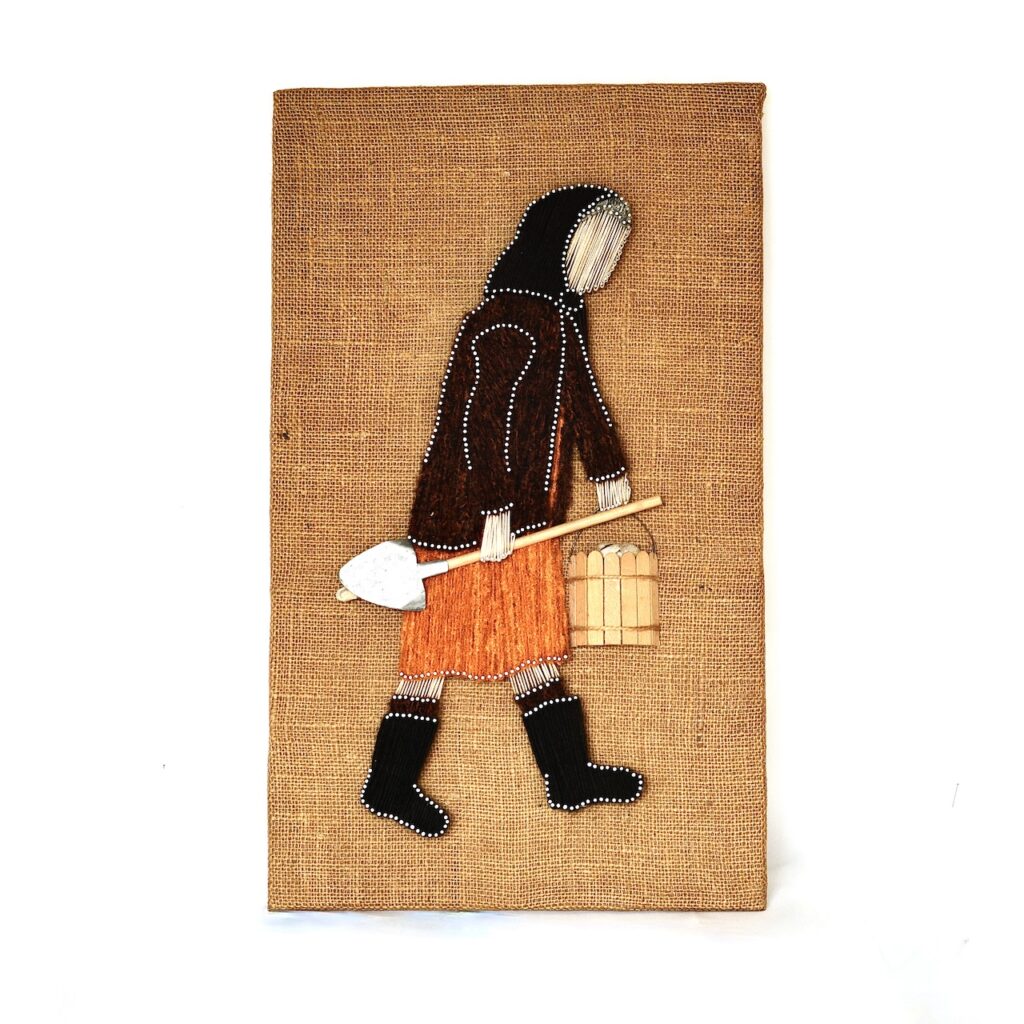
Recently I came across this delightful work of art depicting the clam digger. This piece is signed by the artist, and is from New Brunswick, the east coast of Canada. You will notice she has a bucket full of clams along with her trusty spade.
Many of the vintage string art finds are abstract circles and angles, or various different types of boats, and a few owls. There are very few remaining that depict cultural scenes of a given area. I did see one of a Native American Indian on a horse, and another of a mallard duck in flight.
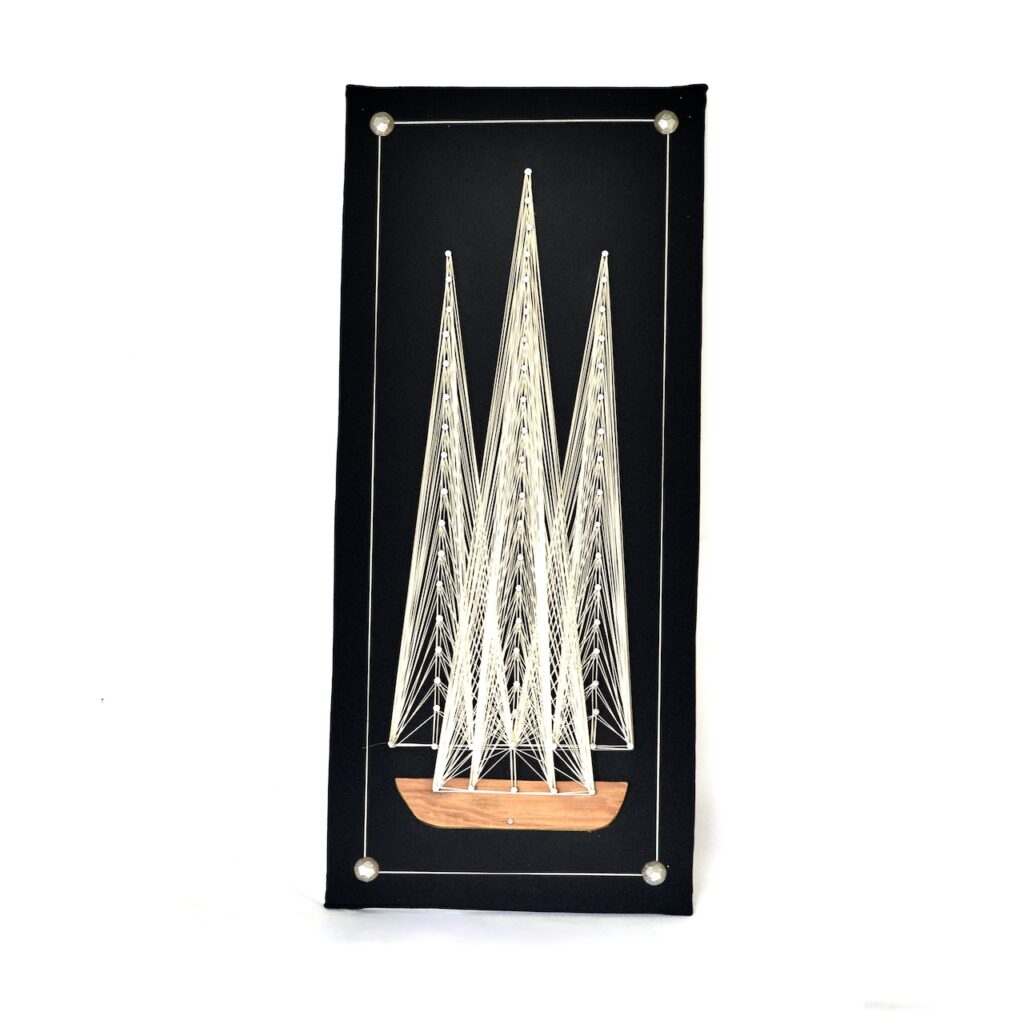
At the end of this post I have included a sample of a string art sail boat on a black background. The string art boats seem to be the most common.
But so far, this is the only string art clam digger shown anywhere online. It is definitely a cultural representation of the Atlantic east coast. The artist signature on the back top left corner, appears to be Ginette Robichaud.


Copyright Valerie J. Hayes and Quiet West (2024). Unauthorized use and/or duplication of this material without express and written permission from this blog’s author/owner is strictly prohibited. Excerpts and links may be used, provided that full and clear credit is given to Valerie J. Hayes and Quiet West with appropriate and specific direction to the original content.


